Pre-Engineered Buildings
How Much Does a Steel Building Cost in Ontario? (2026 Guide)
A clear breakdown of pre-engineered steel building costs in Ontario for 2026 — price per square foot, what's included vs. extra, foundation and permit costs, insulation, snow loads, and example builds.
Quick answer
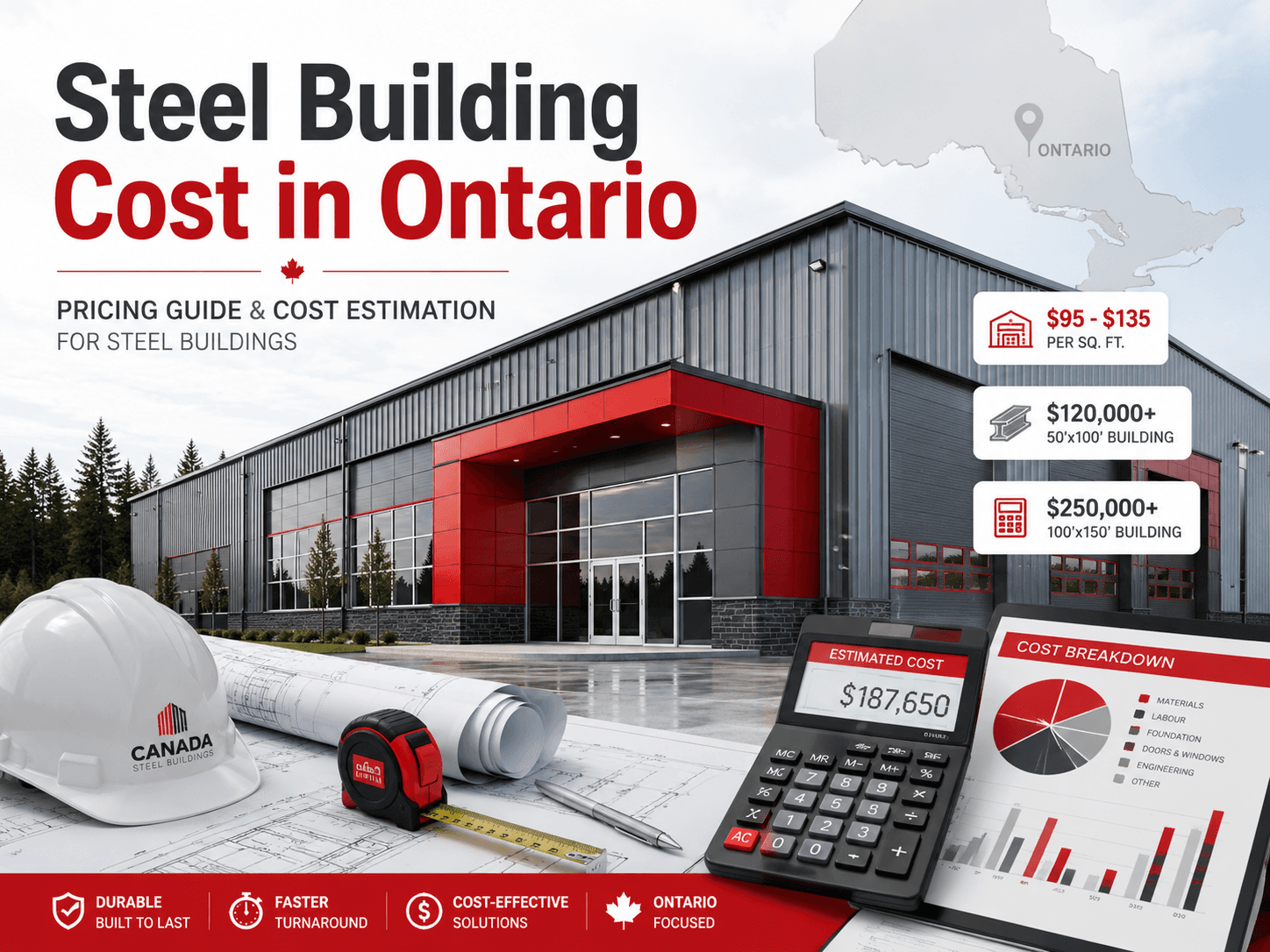
In Ontario in 2026, a steel building kit (shell only) typically runs about $18–$35 per square foot, while a fully installed, turnkey building generally lands around $40–$80 per square foot once you add the foundation, erection labour, insulation, openings, permits, and site work.
The single most important thing to understand before budgeting: the "price per square foot" you see advertised almost always refers to the steel shell only. Most of the confusion buyers run into comes from comparing a shell-only number against a turnkey number. They are not the same scope, and the gap between them is where the real budget lives.
This guide separates those layers so you can plan accurately from the start.
What's included in a steel building "kit"
A pre-engineered metal building (PEMB) kit is the engineered skeleton and envelope of the structure. A typical kit includes:
- Primary steel framing (the main rigid frames or columns)
- Secondary framing (girts and purlins)
- Roof and wall panels
- Standard trim, flashing, and closures
- Fasteners and anchor bolts
- Stamped engineering and erection drawings
What a kit price almost never includes:
- Concrete foundation or slab
- Erection (assembly) labour
- Site preparation, grading, and drainage
- Insulation and interior liner panels
- Overhead doors, windows, and man-doors beyond the basics
- Electrical, mechanical, and HVAC
- Permits, development charges, and HST
When you compare quotes, go line by line and confirm which of these are in or out. A lower headline price often just means more items have been excluded.
Price per square foot at a glance
These are planning ranges for Ontario in 2026. Your real number depends on the specifics below.
| Scope | Typical range (CAD / sq ft) | What it covers |
|---|---|---|
| Tubular / light-gauge kit | $12–$18 | Best for garages and small storage |
| Red-iron commercial kit (shell) | $22–$35 | Structural I-beam frame, warehouses, shops |
| Erection labour | $5–$22 | Varies with size, height, and crane needs |
| Concrete slab | $6–$12 | 4" slab to heavy-duty reinforced slab |
| Fully installed / turnkey | $40–$80 | Kit + foundation + labour + basics |
Larger buildings cost more overall but less per square foot, because structural efficiency improves and fixed costs spread across more area. A simple 30×40 garage might average around $35/sq ft, while a 60×120 warehouse can fall closer to $28/sq ft on the shell purely from scale.
The main cost factors
The biggest drivers of your final price are:
- Building size — total square footage and the width-to-length ratio.
- Clear span vs. columns — a column-free interior (for a hangar, arena, or large warehouse) needs heavier framing and costs more than a building with interior support columns.
- Eave height — taller walls mean more steel and more demanding engineering.
- Roof style and pitch — steeper or more complex roofs add material and labour.
- Snow and wind loads — driven by your exact location (see below).
- Foundation type — slab thickness, frost walls, and soil conditions.
- Insulation package — from none, to basic blanket insulation, to a fully conditioned envelope.
- Openings — every overhead door, window, and man-door must be engineered and framed; more openings means more cost.
- Delivery distance — freight from the fabrication plant to your site.
- Installation timeline — rushed schedules and busy seasons raise labour rates.
Foundation costs in Ontario
The steel sits on concrete that is usually not included in the building quote, so budget it separately. A standard concrete slab generally runs $6–$12 per square foot depending on thickness and reinforcing.
Ontario adds an important wrinkle: frost depth. Canadian foundations have to go deeper than most US projects, and many commercial builds need frost walls. For a typical commercial build, frost walls plus slab can add roughly $15,000–$35,000 on top of the slab itself. Site preparation — excavation, grading, gravel base, and drainage — commonly adds another $3–$6 per square foot.
Permits and approvals in Ontario
Permit costs vary widely by municipality, and the municipal fee is only one piece. The real permit budget can include engineering drawings, foundation coordination, site plans, applicable-law approvals, and sometimes geotechnical or civil work. Building permit fees alone commonly fall in a few-hundred to a few-thousand dollar range, but larger urban projects can be considerably higher.
A project in Toronto, Vaughan, Brampton, Mississauga, or Barrie can have very different permit, site-access, and engineering requirements than a rural build, so always confirm with the local building department before locking in a budget.
Why your Ontario location matters
Ontario's building code (NBCC 2020 as adopted provincially) sets snow and wind loads by region, and those loads directly change how much steel your building needs. Ground snow loads range from roughly 25 PSF in the Windsor area to over 60 PSF in Northern Ontario. Heavier snow loads require stronger framing — which means more steel and a higher shell price.
Freight is another location factor. Expect roughly $1–$3 per square foot for delivery and off-loading, depending on distance from the plant and how accessible your site is.
That's why an accurate quote has to be based on the actual property location, intended use, and required dimensions — not a generic per-square-foot figure.
Example builds (planning estimates)
These are ballpark, installed (turnkey) ranges for Ontario in 2026. Use them to frame conversations, not to approve a final budget.
- 30×40 garage / workshop (1,200 sq ft): roughly $48,000–$96,000 installed, depending on finish level.
- 60×100 commercial shop (6,000 sq ft): kit alone often $80,000–$130,000; turnkey commonly $150,000–$300,000+ depending on insulation, doors, and foundation.
- Insulated warehouse with dock doors and an office build-out: sits at the top of the range once full electrical, heavy insulation, and a higher-spec foundation are added.
How to get an accurate quote
To get pricing that actually reflects your project, have these ready:
- Approximate dimensions — width, length, and eave height.
- Property location — for snow/wind loads, permits, and freight.
- Intended use — storage, agricultural, commercial, industrial, riding arena, etc.
- Openings — number and size of overhead doors, man-doors, and windows.
- Insulation and finishing expectations — bare shell vs. conditioned space.
- Foundation status — is the site graded? Do you know the soil conditions?
The more of this you can provide, the tighter and more comparable your quotes will be.
Frequently asked questions
Is a steel building cheaper than traditional construction? Often, yes. Pre-engineered steel is pre-cut and pre-drilled, which can cut on-site labour and build time significantly versus conventional framing. Steel is also fire-, mold-, and pest-resistant, which can lower long-term maintenance and insurance costs.
Does the kit price include the concrete? No. In almost all cases the foundation is quoted and built separately. Always confirm.
Why do two quotes for the "same" building differ so much? Usually scope. One quote may be shell-only while the other is turnkey, or one includes insulation, doors, and erection while the other doesn't. Compare line by line.
Will prices drop in 2026? Industry forecasts point to relatively flat or slightly higher steel costs versus 2025, with labour and transport offsetting any small material dips. Planning around current prices with a modest contingency is sensible.
Get a steel building quote
For a more accurate estimate, prepare your approximate building size, property location, door requirements, and intended use — then request a project-specific quote.
Figures in this guide are 2026 planning ranges for Ontario and are not a quote. Final pricing depends on your exact site, design, loads, and engineering scope. Always confirm requirements with your supplier and local municipality before committing to a budget. Figures in this guide are 2026 planning ranges for Ontario and are not a quote. Final pricing depends on your exact site, design, loads, and engineering scope. Always confirm requirements with your supplier and local municipality before committing to a budget.